The Threat Behind Business Email Compromise
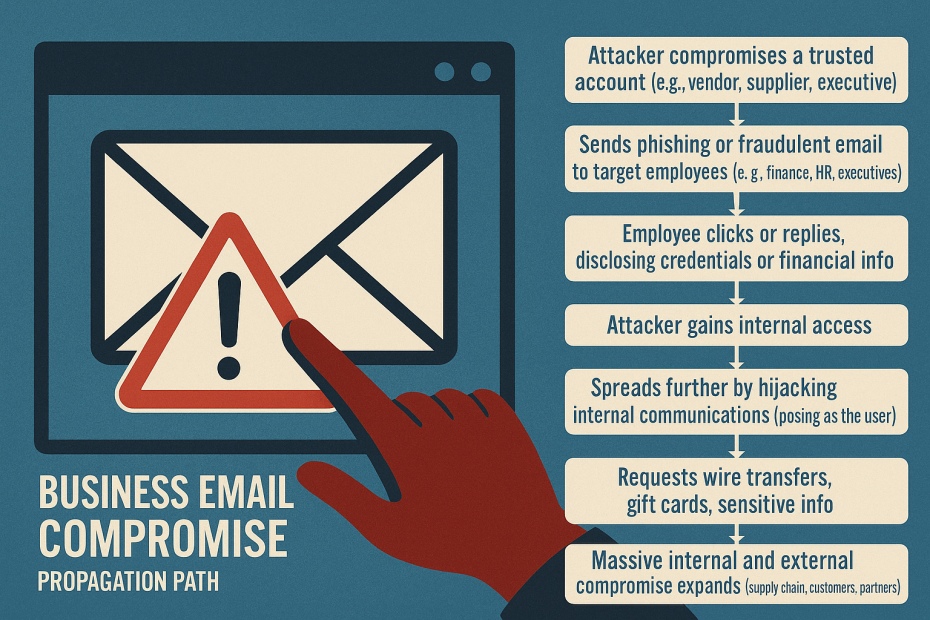
Business Email Compromise (BEC) is no longer just about a single fraudulent message or a spoofed CFO wire request. It has evolved into a multi-stage threat, often leveraging legitimate, compromised email accounts of trusted partners to gain access, escalate privileges, or deliver payloads that bypass traditional defenses.
The result? An alarming rise in widespread compromise—not because users clicked a link from a stranger, but because they clicked a document or link from a real vendor or a previously trusted domain.
The New BEC Supply Chain Threat
Modern BEC campaigns often start with the compromise of a vendor or partner email account. This initial breach then becomes the launchpad for malicious emails that ripple outward—not flagged by spam filters, not marked suspicious by end users, and almost always trusted by default.
These emails often include:
Invoices laced with malware or malicious macros SharePoint or Google Drive links leading to credential harvesting pages Replies to legitimate threads with embedded malicious content Change of banking details used to redirect wire transfers
Because the threat originates from a real account with legitimate sending history and relationship context, traditional filters like SPF/DKIM/DMARC or anti-spam scoring are often ineffective.
Real-World Example: The Vendor Cascade
Consider this chain reaction:
A marketing agency is compromised. The attacker waits and monitors communication patterns. At the end of the month—when invoice cycles hit—they reply to existing threads with updated “banking info.” That same attacker now has visibility into your organization’s emails via replies. They pivot to your accounting department, impersonate your internal staff, and spread poisoned links further.
This isn’t a theoretical risk—it’s happening daily across industries, from hospitality to finance.
Why It Works
The success of these attacks hinges on trust:
Trust in sender identity: The email is really from a partner. Trust in context: The email continues an active thread. Trust in platform: Many payloads are hosted on cloud platforms (e.g., OneDrive, Dropbox) that are not flagged as malicious. Trust in process: Most users don’t verify banking changes or shared drive links.
How to Break the Chain
Stopping this kind of compromise requires layered defenses—not just at the technical level but across people and processes.
Implement Inbound and Outbound Email Anomaly Detection
Use tools that flag contextual anomalies—a vendor suddenly sending ZIP files when they never have before, or sending from an IP region they’ve never used. Leverage machine learning-based anomaly detection that evaluates sender behavior, tone, and asks from an email conversation, not just key words.
Monitor and Authenticate Changes in Financial Communications
Enforce out-of-band confirmation of banking changes or invoice updates (e.g., a quick phone call to a known contact). Establish vendor verification procedures for any payment modification requests.
Educate Your Workforce Continuously
Move beyond annual training—use phishing simulations, quick awareness micro-courses, and real-world scenario discussions. Teach users how to spot subtle signs of compromise: mismatched URLs, altered invoice templates, or unexpected urgency.
Final Thoughts
BEC is no longer just a “you problem”—it’s a network problem. Organizations are only as strong as the weakest link in their communication chain. When a vendor or partner is compromised, you become the next target.
It’s time to stop thinking of email as a static system with clear boundaries. Instead, treat it like a living, breathing web of risk—where every connection point must be verified, continuously monitored, and fortified.
Want help evaluating your BEC risk posture or building an action plan? Reach out—I’ve helped teams build layered defenses that work in the real world.